Fitness and nutrition advice is everywhere. Social media, magazines, your coworker who just started a new diet, the person next to you on the treadmill. The problem is that a lot of what gets passed around as common knowledge is simply wrong, and some of it is quietly working against your progress.
At No Limit Personal Training in Placentia, we hear these myths from new members regularly. People avoiding perfectly healthy foods, skipping meals to lose weight, or staying away from weights because they are afraid of what will happen. It is worth clearing the air.
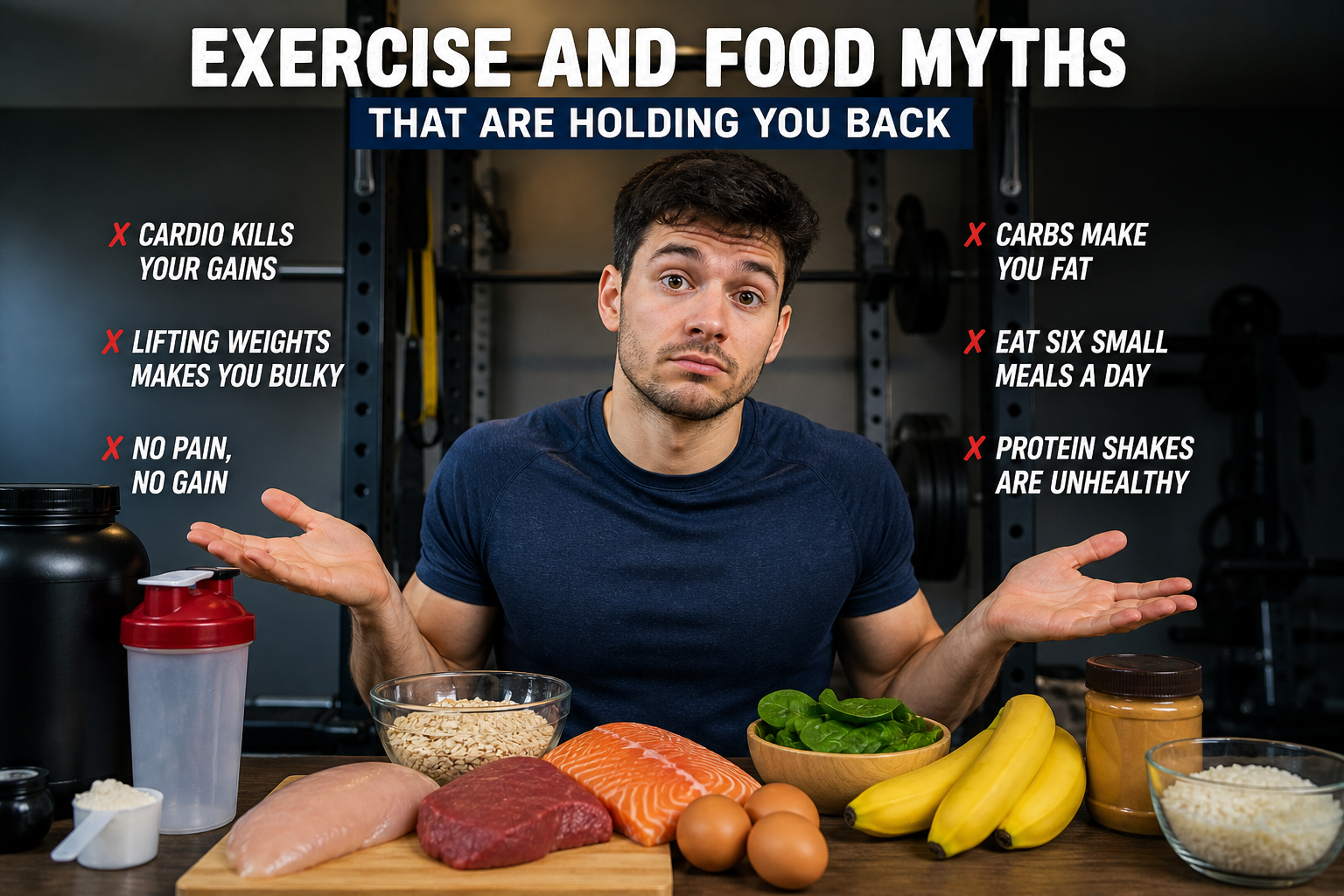
Here are the most common exercise and food myths we see holding people back, and what research actually says about each one.
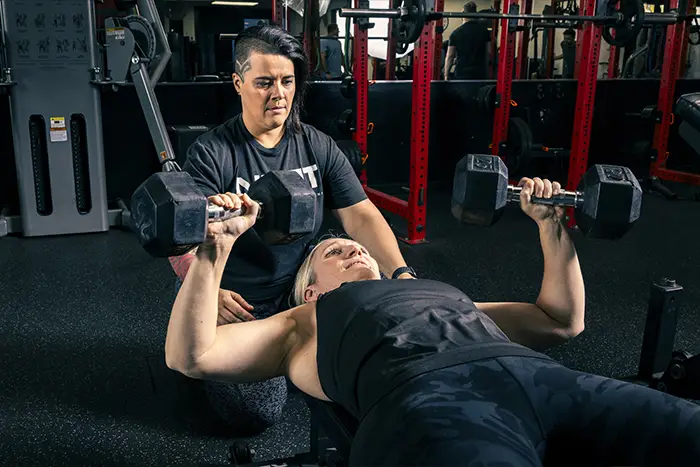
Myth 1: Lifting Weights Will Make Women Bulky
This is probably the most persistent myth in fitness and it has kept countless women away from the training that would help them most.
Why Women Do Not Bulk Up From Lifting
The short answer is hormones. Building large, bulky muscle mass requires testosterone levels that women simply do not have. Women produce roughly 10 to 20 times less testosterone than men. Even men who train seriously for years rarely achieve the kind of muscular size that people associate with the word bulky.
What heavier lifting actually does for women is produce a leaner, more defined physique. It reduces body fat, increases muscle density, improves posture, and creates the toned appearance most women say they want. The women who look heavily muscular in fitness photos have typically spent years of dedicated training and often use hormonal support to achieve that look. It does not happen accidentally from three sessions per week.
Research consistently confirms that women who strength train lose more body fat, maintain more lean muscle, and improve body composition more effectively than women who rely on cardio alone.
What to Do Instead
Stop avoiding heavier weights. A weight that challenges you in the 8 to 12 rep range builds the muscle and strength that produces real visible change. Light weights with endless reps keep you comfortable but do not produce the same results.
Myth 2: Nuts and Seeds Will Make You Gain Weight
Many people, particularly women trying to lose fat, avoid nuts entirely because they are high in calories. This is one of the most counterproductive nutritional decisions you can make.
The Truth About Healthy Fats
Nuts and seeds are calorie-dense, yes. But research consistently shows that people who eat nuts regularly do not gain more weight than those who avoid them, and often have better body composition outcomes.
A study published in the Journal of Nutrition and Metabolism found that incorporating nuts into meals did not cause weight gain over 12 weeks. Research has also shown that the body does not absorb all the calories in nuts because their cell structure limits digestion. A significant portion passes through without being fully metabolized.
Beyond that, nuts and seeds provide monounsaturated and polyunsaturated fats, including omega-3 and omega-6 essential fatty acids, that support heart health, brain function, hormone production, and reducing chronic inflammation. They also provide fiber and protein that increase satiety and reduce overall calorie intake throughout the day.
Avoiding them in an attempt to save calories often backfires by leaving you hungrier and more likely to overeat on less nutritious food later.
What to Do Instead
A small handful of almonds, walnuts, or mixed seeds as a snack paired with a protein source is one of the most blood-sugar-stable options available. The key, as with any food, is portion awareness rather than avoidance. Understanding nutrition mistakes that hinder muscle gains helps put choices like this in the right context.
Myth 3: Skip Breakfast to Lose Weight
Skipping breakfast seems like a logical calorie-cutting strategy. Fewer meals, fewer calories, less fat. Except it rarely works that way in practice.
What Research Says About Breakfast
When you sleep, your body goes without food for seven to nine hours. Skipping breakfast extends that fast through the morning, which sounds good on paper. In practice, research shows that people who skip breakfast tend to eat more calories later in the day, make poorer food quality choices by afternoon, and experience greater blood sugar swings that drive cravings.
A study in the American Journal of Clinical Nutrition found that people who ate breakfast consumed fewer total daily calories than breakfast skippers, and were more likely to meet micronutrient needs throughout the day.
For adults who strength train, skipping breakfast also means delaying the first protein intake of the day, which slows muscle protein synthesis during a window when the body is primed to use it after an overnight fast.
The Intermittent Fasting Caveat
Time-restricted eating and intermittent fasting are legitimate approaches that some people do well on. But structured fasting is different from haphazardly skipping breakfast because you ran out of time or thought it would help you eat less. If you are going to delay your first meal, plan it intentionally and make sure your protein intake across the remaining meals is adequate.
What to Do Instead
A breakfast built around 25 to 35 grams of protein, eaten within one to two hours of waking, stabilizes blood sugar, reduces afternoon cravings, and gets you halfway to your daily protein target before the morning is over. For more guidance read our post on tips for eating healthier after 40.
Myth 4: Eating at Night Causes Weight Gain
The rule of not eating after 8pm is popular enough that many people treat it like a law of physics. It is not.
What Actually Causes Weight Gain
Weight gain is driven by total calorie intake relative to total calorie expenditure over time. Not by the clock. If your daily calorie needs are 2000 and you have 400 calories remaining at 9pm, eating those calories does not cause fat storage that would not have occurred if you had eaten them at 6pm.
Research on meal timing and weight gain is nuanced. Some studies suggest that late-night eating is associated with weight gain, but largely because people who eat late at night tend to eat more total calories overall, not because timing itself is metabolically distinct in a meaningful way for most healthy adults.
Where timing does matter is around training and sleep quality. A large, heavy meal very close to bedtime can disrupt sleep quality, which as we covered in a separate post, does affect body composition over time. But a sensible meal in the evening from a food quality standpoint is not the enemy.
What to Do Instead
Focus on what you are eating and how much across the whole day rather than enforcing an arbitrary cutoff time. Late-night overeating on processed food is a problem. A balanced dinner at 8pm is not. If you are curious about approaches that do not involve constant calorie counting, our post on losing weight without exercise covers some useful habits.
Myth 5: Crash Diets and Fad Diets Work
Every few years a new approach promises rapid results. Extreme restriction, single-food protocols, cutting entire macronutrient groups. Some produce short-term weight loss. None of them produce lasting results and most leave you worse off than when you started.
Why Crash Diets Backfire
Severe calorie restriction triggers several counterproductive responses in the body. Metabolic rate drops to match reduced intake, making further weight loss progressively harder. Muscle tissue is broken down alongside fat because the body looks for protein to fuel basic functions when intake is very low. And when the diet ends, which it always does because extreme restriction is not sustainable, the body preferentially restores fat stores while the metabolic rate remains suppressed for weeks to months afterward.
Research from the University of Melbourne followed participants from The Biggest Loser television program for six years after their competition ended. Despite significant weight regain, their resting metabolic rates remained dramatically lower than expected based on their body size, meaning their bodies had permanently adapted to protect against further calorie restriction.
Fad diets also tend to produce rapid water weight loss in the first week, which shows up on the scale and creates the illusion of dramatic fat loss. That water returns quickly when normal eating resumes, and the actual fat lost is usually much less than the scale number suggests.
What Actually Works
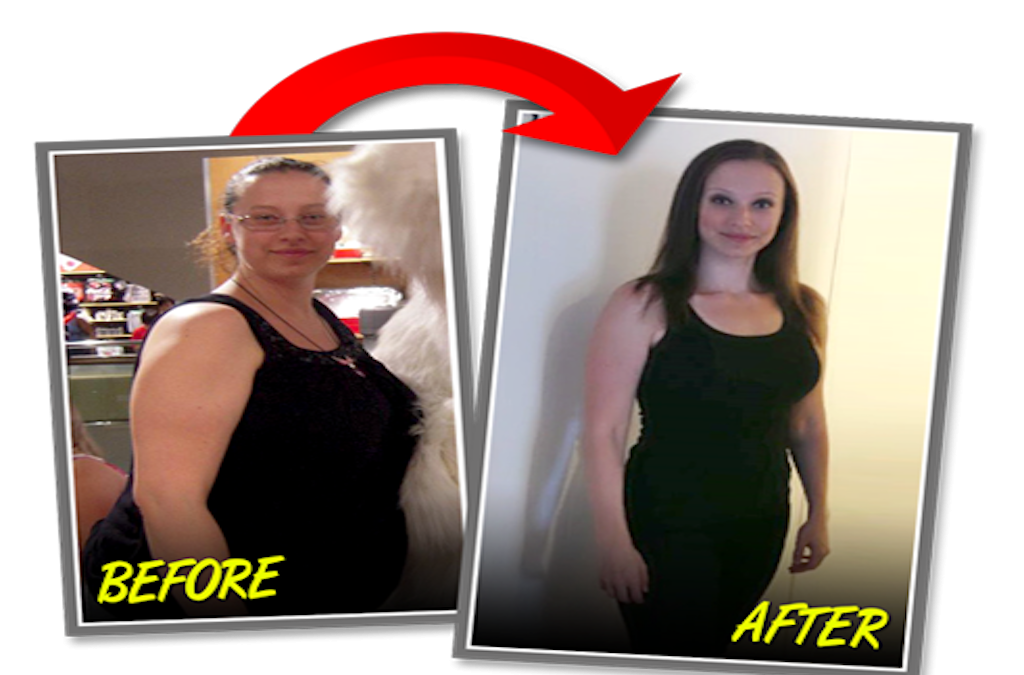
A moderate calorie deficit of 300 to 500 calories per day, combined with adequate protein and consistent strength training, produces steady fat loss while preserving muscle. It is not dramatic. It does not make for compelling before and after photos in week two. But it produces results that last. Understanding making better food choices when eating out is a more practical and sustainable focus than following any restrictive protocol.
Why These Myths Persist

Most of these myths survive because they contain a grain of truth or because they appeal to the desire for a simple rule in a complicated space. Women did bulk up from certain training styles. Nuts are calorie-dense. Skipping meals does reduce opportunities to eat. Late-night overeating is a real pattern. Restricting calories does produce initial weight loss.
The problem is that each of these partial truths gets stripped of its context and turned into a blanket rule that misleads more than it guides.
Good nutrition and training are nuanced. What works is not always what sounds most logical on the surface. That is exactly why working with coaches who understand the evidence and apply it to your specific situation produces better outcomes than following rules you read on a wellness blog a decade ago.
Who This Is For
This post is for adults who want to separate real evidence-based guidance from the noise that circulates in fitness and nutrition spaces. It is for people who have been following rules that are not producing results and want to understand why.
It may be for you if you:
- Have avoided certain foods or food groups based on advice that never quite worked
- Train consistently but feel confused about nutrition
- Want to stop guessing and start following an approach grounded in research
- Live near Placentia, Orange, Anaheim Hills, Villa Park, or anywhere in Orange County
- Want coaching that covers both training and nutrition together
How NLPT Cuts Through the Noise
At No Limit Personal Training, we do not follow trends. We build programs around what research consistently supports and what works for real adults with real schedules, real stresses, and real goals.
Our coaches help members understand nutrition in a way that fits their lives rather than following rules that make no sense in practice. If you want to know exactly what we do and how we do it, learn more about the NLPT team and the approach that has helped adults in Orange County get results since 2009.
View NLPT membership pricing and find the option that fits your schedule and goals.
What to Do Next
The most productive thing you can do with this information is stop applying rules that are not working and start building habits that are based on how your body actually responds. That takes guidance, consistency, and a program that is built around you.
You can reach us at (714) 909-1203 or email info@nolimitpt.com. We are at 980 S Via Rodeo, Placentia CA, just minutes from Yorba Linda, Anaheim Hills, and Orange.
Stop following myths. Start following a plan.
Frequently Asked Questions
Will lifting weights make women bulky?
No. Women do not have the testosterone levels required to build large bulky muscle mass from regular strength training. What lifting actually produces for women is a leaner, more defined physique with improved body composition, better bone density, and a higher resting metabolic rate.
Are nuts bad for weight loss?
No. Research consistently shows that people who eat nuts regularly do not gain more weight than those who avoid them. Nuts provide healthy fats, protein, and fiber that support satiety and reduce overall calorie intake. Portion awareness matters but avoidance is unnecessary and often counterproductive.
Is breakfast the most important meal of the day?
Research shows that people who eat breakfast tend to consume fewer total daily calories and make better food choices throughout the day. For adults who strength train, a protein-rich breakfast is particularly valuable for supporting muscle protein synthesis and reducing afternoon cravings.
Does eating late at night cause weight gain?
Not by itself. Weight gain is determined by total calorie intake versus total calorie expenditure over time, not by the clock. Late-night overeating causes weight gain because of the excess calories involved, not because of the timing specifically.
Do crash diets work for long-term fat loss?
No. Crash diets produce short-term weight loss that is largely water weight, trigger metabolic adaptation that makes further loss harder, break down muscle alongside fat, and almost always result in weight regain when the restriction ends. Moderate calorie deficits with adequate protein and consistent training produce results that last.